Sunday, February 24, 2019

Why does a major food producing country like Bangladesh import any food at all?

In the whole world, there is no country which is specialized in all the products. For this reason, being a major food producing country like Bangladesh imports any food at all. In some food cases, the production cost is higher than the importation cost and sometimes many cases importation cost is higher than the production cost. Because specialization factor is behind it.
Though Bangladesh is a major food producing country, it imports some commodities in which it isn’t specialized. It hasn’t the comparative advantage of these products and the production cost is higher than the importation cost.


Sunday, September 9, 2018

Why is marketing so important?

At first we have to know what is marketing?

Marketing is the study of exchange relationship between buyers & sellers. Marketing is used to create, keep and satisfy the customer needs ,want & demand.

According to Peter F. Drucker , "the aim of marketing is to know & understand the customer so that the product or service fits for them".
This definition suggests that to be successful in marketing you need to thoroughly understand you audiences.
know things like their ages, income,sex.region,hobbies & many other things. We can develop our product to meet customers wants & needs because we already learn that product should sell itself. We need not to do anything for selling. Just to make the right product for the right customers.
 The importance of marketing are-

  • marketing create the public awareness of the product
  • builds company reputation
  • helps to boost sales
  • builds trust among customers
  • create brand value


Wednesday, January 10, 2018

Number of channel levels

Channel level:
Channel level is a layer of marketing intermediaries who performs some work in bringing the product & it's ownership closer to the final buyer. Producer & the final consumer also a part of every channel because both are perform all work.

The number of marketing intermediary levels shows it's length of a channel.  Here two types of marketing channel are found .


1. Direct marketing channel:  It has no intermediary levels. Company's sell directly to consumers. In the figure A, look at channel 1 , it's it's example of direct marketing channel. For example:- a cosmetics producer sell their products door to door, online selling , hon or offices sales parties  are direct marketing channel.  Rest two  Channels are the example of indirect marketing channel.

2. Indirect marketing channel :- It containing one or more intermediary levels. See the figure; channel 2&3 are the example of indirect marketing channel because here consists one or more intermediaries  who bring the product in the market or final consumers.

From the producer's point of view , having greater levels of intermediaries means less control & more complexity.  Moreover , all the institutions in the channel are connected by many flows  including physical flow, ownership flow, payment flow, information flow & promotion  flow . This flow can make very complex channels with one or a few levels.


How channel members add value

Why do producers give some of the selling job to channel partners?

It happens because giving up some control over how & to whom they  sell their products . Producers  seek intermediaries because they're  the only one who bring products to market  through their contracts,  experience,  specialization  & scale of operation, intermediaries.


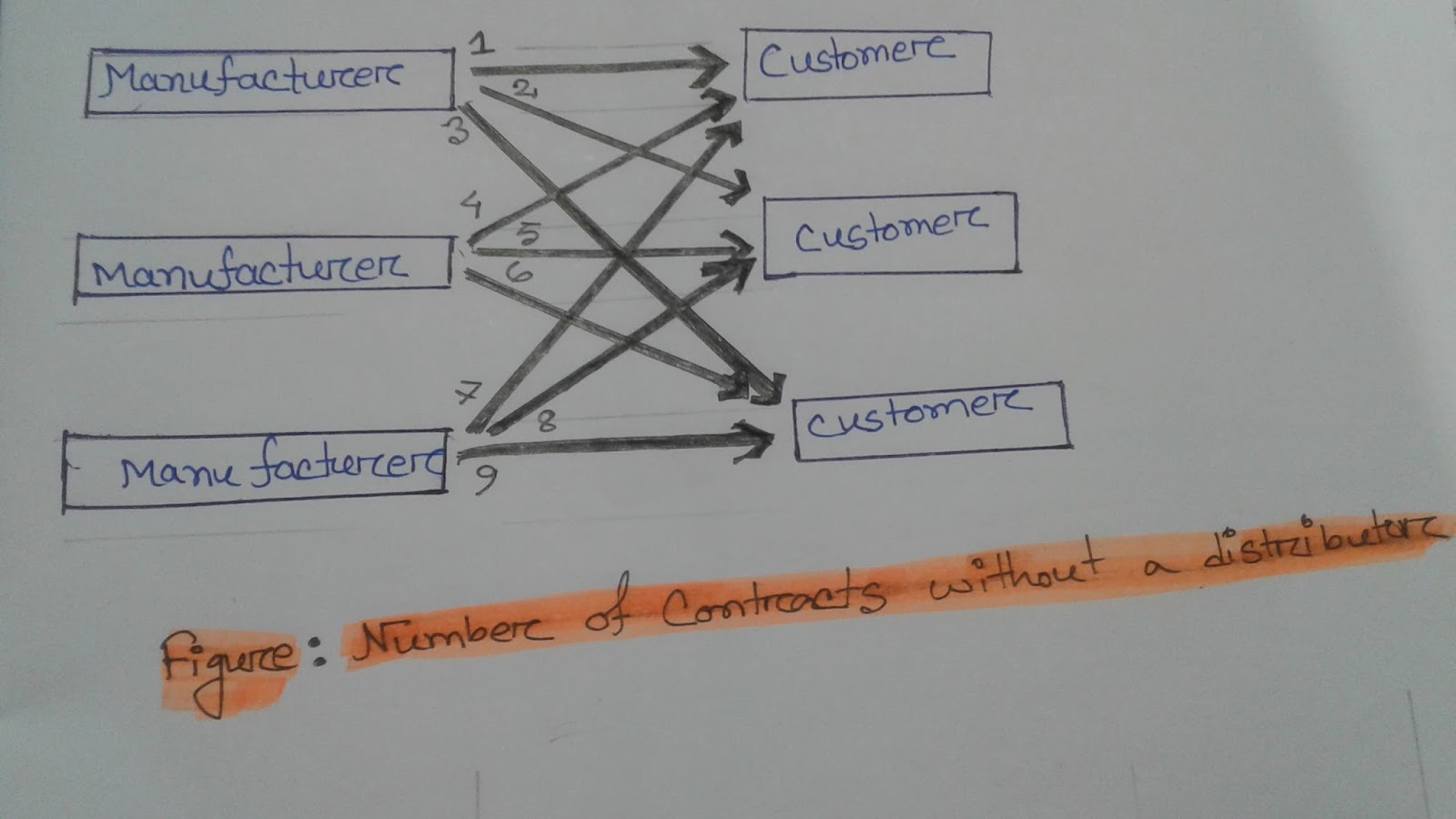
In this section , three manufacturers are found . Everyone use direct marketing to reach three customers .This system requires needs nine different contacts.

Above figure shows that three manufacturers working through one distribution channel; this distributor contacts three customers. It needs only six contacts. In this above way, distributors reduce the work of both producers & customers. 

From the economic's system point of view, the role of marketing intermediaries always transfer the product into different categories & provide to customers  how many or how much they want. At first , producers produce large quantities of product under narrow assortment but consumers  want large assortments of product into small quantities.  That's why marketing intermediaries work for it. They buy large quantities from producers & break them down into the smaller quantities or desired by consumers.

For example: Unilever every week produce large quantities of toothpaste, soap,shampoo, hand wash. Their marketing intermediaries play an important role of distribution this product according to matching of demand & supply.

Marketing channel member add value by making product available  to consumers. Members also have available time, place, possesion gaps that separate goods & services from those who use them. Marketing channel members perform many key functions.  This're:-

● Information :- It is a way of gathering & distributing information about consumers, producers, suppliers & other forces of marketing environment;  They needed do planning & aiding exchange.

● Promotion:-This is the way of developing  & spreading persuasive communication  about an offer .

● Contact:- It's finding & communicating with prospective  buyers.

●Matching :It 's mainly shaping offers to meet tbe buyees needs incluing activities shch as manufacturing, grading , assembling & packaging.

● Negotiation:- They reach an agreement on price & other terms so that ownership & possession can be transferred easily.

●Physical  distribution:- This is actually transporting & storing goods.

● Financing:- It's acquring & using funds to cover the costs of the channel work.

● Risk taking:- Measuring the risks of carrying it the channel work.

It's not necessary to perform all the functions  but who  maintain  all this probably  it costs go up then price must be higher. If some are not perform then costs & prices may be lower . Here, one thing we should mention that the various functions should be assigned to the channel members who can add the most value for the cost.


The nature & importance of marketing channels

Some producers like to sell their goods directly to final users . On the other hand, most producers use intermediaries to bring their products to market.
Always ,  They seek for marketing channel. Marketing channel actually a set of interdependent organizations that works for make a product or service available for use or  consumption  by the consumer or business user.
Marketing decisions are directly affected by a company's channel decisions. They set their pricing based on their nature of working environment with national discount chains, uses high quality, specialty  stores, direct sells or online sells.
It's sales force & communications decisions depend on their ability to persuasion, motivation, training & support channel partners.
Besides, company's develops their new products depends on  how well those products  do the capabilities of its channel members.
Some companies pay little attention to their distribution channels having of damages. In contrast, some companies used imaginative distribution channels system to gain competitive advantage.
For example:- by setting up off airport rental offices  of Rent a car businessman gets competitive advantage. Apple also gets through retail music business  by selling iPod via the internet on iTunes music.
Amazon & Wal-Mart always changed their face of retailing & without Having any physical stores.
Distribution  channel is always a long -term commitments to other firms . For example:- leading companies like Ford, McDonald's, pizza hut, HP can easily Change their advertising , pricing or promotion programs. They can stop their on product & introduce new one for market tastes demand. But after setting distribution channels  through contracts with franchisees, independent  dealers, large retailers  can't  replaced this immediately.  That's why management needs to design  their channels carefully  today's & tomorrow's  as well.

Explanation of Supply chains & the value delivery network

After producing a product or service , marketers try to make this product or service available to buyers requires building relationships not only the customers but also the key suppliers & resellers in the company's supply chain.

The supply chain consists of two partners ; one is upstream & another is downstream .
Upstream always done by company's suppliers who supply the raw materials, Components, parts, information, financed & expertise needed to create a product or service.
Traditionally,  marketers focused on the downstream side of the supply chain like marketing channels more appropriately distribution channels that look toward the customers.Wholesellers & retailers are the downstream marketing channel partners.They form a vital link btween the firm & it's customers.
The term supply chain considered as too limited beacause in the view of business it takes a make & sell.  It includes :-

■ raw materials;

■ productive inputs;

■ factory capacity .

This all serve the starting point for marketing planning.
Here, a better term found that's demand chain.Why should we call demand chain???
Because this chain suggests a sense & repond view of the market.

Under this view, marketing plan starts through :-

● identifying the needs of target customers;

● company should respond by organizing a chain of resources;

● the goal of creating customer value.

Demand chain also considered as too limited. Because it takes a step by step as like three linear view of purchase - production -consumption activities.

Now-a-days,  many last companies trying to building & managing complex & repeatedly evolving delivery network. Value delivery network is related to company suppliers distributors & finally customers. They partner with each other to improve their performance of the total system in delivering customer value.

For example:- " Yellow " a leading clothing brand always manage its suppliers  & dealers outside the company who work together  to give final customers an innovative design.


Wednesday, October 25, 2017

Define the steps in the new product development process.

A company must adopt strong product planning & set up a systematic , customer driven new product development process.
In this development process, it has eight major steps.

1. Idea generation: Development starts with idea general. It is a systematic search for new producr ideas.  This ideas include inrernal & external sources like as customers, competitors, distributors, suppliers & many others.

🔥Internal idea sources: Companies can collect ideas through research & development.
🔥External idea sources:  Companies can collect ideas from many external sources. For example: distributors & suppliers can give ideas, it can collect ideas from competitors,why customers buy competitors product, analyze their sales  & take decision about their new product.

2. Idea screening:  It is the way to spot good ideas & drop poor ones as soon as possible. It select only one idea among large ideas.

3. Concept development & testing: Product concept helps to distinguish between a product idea, concept & product image. A company can see itself offerings  in the market. A product concept is a detailed version of this idea & product image is the actual  or potential product that consumers perceive.

🔥Concept testing: To find out the attractiveness of the new product,marketers test the concept with a target group of consumers.

4. Marketing strategy development:   New product needs to adopt an intial  marketing strategy based in the product concept. It has three parts. Such as-
🔥Describe the target market,value proposition, present market share, sales & profit for the  first few years.

🔥Product's planned price, distribution & marketing budget for the first year.

🔥Long run sales, profit goals & marketing mix strategy.

5. Business analysis:  Total review over the sales,costs & profits for a new product to find its attractiveness to satisfy the company's objectives.

6. Product development: After passing the previous steps, new -product moves into product development. Through R&D , marketers develop the product concept into physical product. Its develop, add new feature ,design, quality to satisfy the target customers.

7. Test marketing:   After passing the concept test & product test , the next step is test marketing. This is way of introducing the new product in the realistic market. Test marketing is needed for analysing the new product attractiveness in the market whether it can cover up the cost or not.

8. Commercialization:  It is the full introduction of a new product in the target markets. Here,test marketing helps the marketers to take their decision about launching the product. Introducing a new product in the market  will face high costs.  Marketers choose a perfect time to launch the product & also select a single location, region, national market & the international market for launching the product.

This all  the  new product development  process.